🧗
Yosemite National Park
CA
Est. 1890
748,436 acres
Log in to track your visit to Yosemite National Park.
⭐ Must-See
• Yosemite Valley
• Half Dome
• El Capitan
• Yosemite Falls
About Yosemite National Park
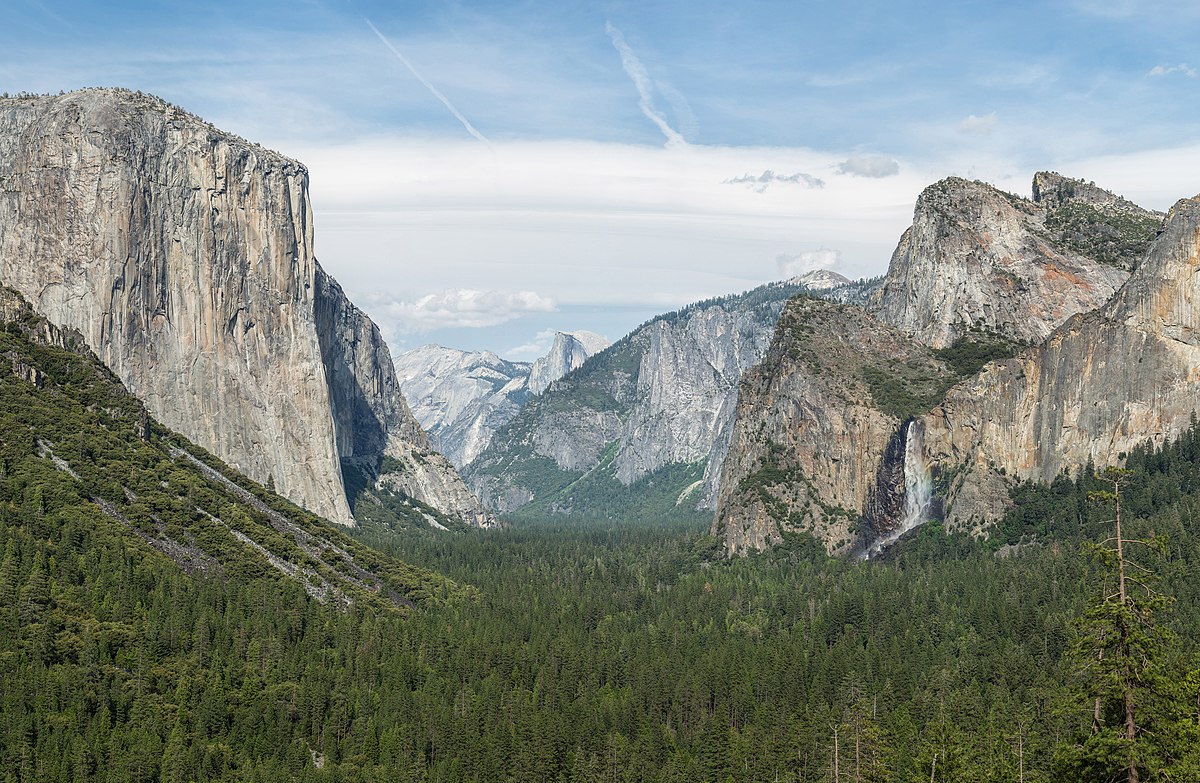
Yosemite National Park is California's most iconic landscape and one of the most photographed places on Earth — a glacier-carved valley of incomprehensible grandeur where 3,000-foot granite walls rise sheer from a flat valley floor carpeted in meadows, dotted with black oaks, and threaded by the Merced River. Established in 1890 after years of advocacy by naturalist John Muir, whose passionate writing helped make Yosemite a symbol of the American conservation movement, the park covers 748,000 acres of the Sierra Nevada, of which 95 percent is designated wilderness. El Capitan — the world's largest exposed granite monolith at 3,000 feet — looms over the valley entrance and has become the defining canvas of the free climbing world since Warren Harding first summited it in 1958 and Alex Honnold climbed it without ropes in 2017. Half Dome's distinctive profile, cleaved as if by a giant blade, rises 4,800 feet above the valley floor and has served as the park's logo since 1920. Yosemite Falls drops 2,425 feet in three tiers — the tallest waterfall in North America — thundering in spring snowmelt and whispering by August. Despite hosting over 3.5 million visitors annually, Yosemite's wilderness is genuine: step a mile off any valley trail and you're in a landscape where bears outnumber people and granite domes stretch to every horizon. Timed entry permits are required in summer to manage crowds — plan ahead, but do not let the planning discourage you. This is one of the world's great natural wonders.
🥾 Things to Do
The Mist Trail to Vernal and Nevada Falls is the most spectacular waterfall hike in the park — a 5.4-mile round trip (to the top of Nevada Fall) that climbs granite stairways through rainbow-lit spray, past two thundering falls, to open views of the high sierra and Half Dome. Half Dome itself requires a permit (lottery through Recreation.gov, opens in March) and a challenging 16-mile round trip with the final 400 feet on steel cables — one of the most thrilling hikes in California. Glacier Point, reachable by car or by the strenuous Four Mile Trail (9.5 miles round trip from the valley), delivers the park's most comprehensive panorama: the entire valley spread below, Half Dome directly opposite, and the High Sierra stretching to the horizon. Tuolumne Meadows, at 8,600 feet via Tioga Road, is the gateway to a completely different Yosemite — a subalpine meadow ringed by granite domes, lakes, and trails into the high country, far quieter than the valley. The Valley Loop Trail (12 miles) circles the valley floor past iconic viewpoints with little elevation gain. Rock climbers come from every continent to attempt El Capitan, Half Dome's northwest face, and hundreds of other routes on valley walls. Ranger-led evening programs at Curry Village and Yosemite Valley Lodge provide excellent natural and cultural history.
🦌 Wildlife & Ecosystems
Black bears are Yosemite's most significant wildlife management challenge — the park's bear population of roughly 300-500 animals has learned to associate humans with food, and food storage regulations are strictly enforced with substantial fines. All food and scented items must be stored in approved bear boxes or canisters — not in cars. Mule deer graze the valley meadows almost daily and are habituated to human presence. Steller's jays and Clark's nutcrackers are bold campsite visitors. Coyotes trot along the valley roads at dawn. In the high country, marmots and pika inhabit talus slopes near Tioga Road. The park's rivers support native rainbow trout and the critically endangered Sierra Nevada yellow-legged frog.
📅 Planning Your Visit
Timed-entry reservations ($2) are required to drive into Yosemite Valley from 5 a.m. to 4 p.m. on most days from late April through early October — book on Recreation.gov the moment the reservation window opens (typically 60 days ahead, with some day-before slots released each morning at 8 a.m. PT). The $35 vehicle entrance fee is separate. Camping in the valley (Upper and Lower Pines, North Pines, Camp 4) is among the most in-demand camping in America — reservations open months in advance and vanish in seconds. The Ahwahnee Hotel (1927) requires booking 6-12 months ahead. Half Dome cables are up late May through mid-October.
🗺️ Getting There
Yosemite Valley is about 190 miles east of San Francisco via I-580/I-205 and CA-120 (Big Oak Flat Road) — roughly 3.5 to 4 hours without traffic. From Los Angeles, the drive is about 5.5 hours via US-395 and CA-120 (Tioga Road, summer only) or via CA-99 and CA-140 year-round. Fresno Yosemite International Airport (FAT) is the closest major airport, about 65 miles west of the valley. YARTS (Yosemite Area Regional Transportation System) runs buses from Merced, Fresno, Sonora, and Mammoth Lakes into the valley — a convenient car-free option.
💡 Visitor Tips
Never leave food unattended or in your car overnight — bear boxes are at every campsite for a reason, and ignoring this results in both property damage and a bear that gets closer and closer to humans until it must be killed. The timed-entry window can sell out but day-before slots release at 8 a.m. Pacific — try for those if you're flexible. Visiting in October or November after the crowds thin dramatically is the park's best-kept secret — waterfalls are low but the light is golden, the crowds are gone, and the valley feels almost as Muir described it. Download the Yosemite offline map before entering — cell service is minimal throughout the valley.
Trails Near Yosemite National Park
Wildrose Peak Trail
CA 8.4 mi Strenuous
Darwin Falls Trail
CA 2.0 mi Easy
Badwater Basin Salt Flats Walk
CA 2.0 mi Easy
East Anacapa Island Loop
CA 1.5 mi Easy
Potato Harbor Trail
CA 4.5 mi Moderate
Cavern Point Loop
CA 2.0 mi Moderate
North Trail Loop
CA 4.5 mi Moderate
Headlands Loop
CA 3.5 mi Easy